
Is Religion Dead?
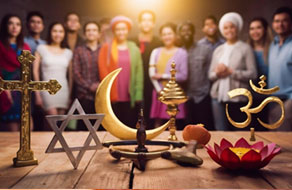
A Hindu Perspective by Dr. Suresh Basrur The question “Is religion dead?” can be rephrased from the Hindu perspective as the question “Is Hinduism dead?” The short answer is, “No. Hinduism is not dead. In fact it is thriving and growing.” Before we examine the current state of Hinduism worldwide, let us first look at the cycles which Hinduism has undergone over the past thousands of years. 1. Hinduism’s cycles of resurgence and suppression:Hinduism has undergone a number of cycles of resurgence, after periods of suppression from external forces, and after periods of diminished interest in society. Development of the Vedas started as early as 4000 BC, and continued until 3000 BC. Sacred scriptures, including Bhagavad Gita, Ramayana and Mahabharata were composed between 2nd century BC, and 4th century AD. Hinduism flourished in India until Gautama Buddha established Buddhism around 500 BC. Rapid growth of Buddhism posed serious challenges to Hinduism. The Maurya dynasty, 323 BC – 183 BC, supported Buddhism. King Ashoka established many Buddhist monuments, and “exported” Buddhism by sending Buddhist missionaries throughout South East Asia and beyond. Hinduism, which suffered a decline through this period and into the first few centuries AD, was given a strong revival by Shankaracharya in the 8th century AD. Shankaracharya traveled throughout India and held brilliant intellectual discourses with the best minds across the country. Hinduism experienced a great resurgence that lasted many centuries. With Muslim incursion into Northern India in 12th century AD, Hindus and their temples in Northern India came under significant oppression, and many temples were destroyed. Mughal emperor Aurangzeb was particularly zealous in his destruction of many temples in 17th century AD. 2. Bhakti (devotion to God) movement :The bhakti (devotion to God) movement was spear-headed by many saints between 15th and 17th century AD. Bhakti focuses on complete surrender of heart and soul to God, without the philosophical emphasis of earlier times. Bhakti appealed to the common man because of its simplicity. The leaders of the bhakti movement – Kabir, Chaitanya, Mirabai, and Tulsi Das, inspired millions to follow the path of bhakti with their spiritual poetry. Kabir transcended the boundaries of Hinduism and Islam, and integrated the best from both religions in his teachings. The bhakti movement provided a counter-balance to the onslaught on Hinduism by Muslim rulers. 3. End of Mughal suppression & start of Reform movement :The Mughal empire’s ruthless attack on Hinduism and Hindus started to weaken after the 17th century. This led to the resurgence of Hinduism, and the discovery of the rich heritage of Hinduism. Great progress in the arts and sciences once again started in the 18th century India. The reform movement of Hinduism was started by charismatic scholars, such as Ram Mohan Roy who founded Brahmo Samaj in 1828. He campaigned against child marriage. Dayanand Saraswati founded Arya Samaj in 1875. He campaigned against the caste system. Ranade founded Prarthana Samaj in 1867. They all galvanized people around the revival of Hindu culture and spiritual heritage. Leaders of the reform movements gave Hindus self-confidence and pride in their country, their religion and their heritage. This was necessary in order to counter the socio-political stranglehold exerted by the British. Ramakrishna Paramahansa (1834 – 1886) was most instrumental in bringing about modern Indian renaissance. He was a mystic with great vision, and his pithy sayings and illustrations were powerful yet easily understandable to the common person. For example, on the problem of evil, Ramakrishna said: “Evil exists in the world as poison exists in a serpent. What is poison to us is not poison to the serpent. Evil exists only from man’s point of view”. That is, in the absolute reality, there is no evil; it exists only in our relative viewpoint. Ramakrishna taught that realization is the essence of religion; and that all religions lead to the same goal. Ramakrishna worked tirelessly for the poor, the uneducated and the underprivileged. 4. World awakens to Hindu wisdom, spirituality & universality :Not much of Hinduism was known to the Western world until the 19th century. That changed in 1893, at the World Parliament of Religions held in Chicago. The brilliant Hindu scholar Swami Vivekananda gave a very impressive and impassioned speech about Hinduism. His spirituality and his communication of the universality of Hinduism impressed the audience so tremendously that the word spread quickly around the globe. Swami Vivekananda’s message so inspired Western scholars of religion and the media that study of Hinduism started to be seriously pursued in the Western world. Vedanta Society was founded by Swami Vivekananda in 1895. Even though he died at the young age of 39, Swami Vivekananda created a deep and lasting impression and influence on the Indian society, and on the world at large. The unique characteristic of the resurgent tidal waves of Hinduism is this: in spite of some outward differences in the Hindu sects (denominations), the strong underlying philosophies, values, ideals, code of conduct, theosophy, and spiritual messages common to all denominations of Hinduism, have united Hindus in each resurgence of Hinduism. The instrumental factor in each revival was strong leadership of a charismatic, brilliant, knowledgeable spiritual leader, who could communicate with people at all levels, cutting across classes, castes, economic strata, and language barriers in meaningful ways. The spiritual leader would show people a path for liberation from strife and suffering in the world, and show simple practical ways to achieve this, by recognizing God in every human being, living organism and nature. 5. The Twentieth Century:Aurobindo Ghosh, a great exponent of Hinduism, gave new interpretations of the Vedas and the Vedanta. In his Essay on the Gita he described Hindu ideals in terms of “the integral view of life”. His great work, The Life Divine, sums up his philosophy of “the Descent of the Divine into Living Beings”. Aurobindo also explained true Yoga as spiritual discipline, not just physical discipline. Self-Realization Fellowship, founded by Parahamsa Yogananda in 1935, has spread all over the world. In the past 50 years, followers of
Hindu Rituals and Routines

January 14, 2018 by richard Hinduism is not a religion but a way of life. Unlike other religions, Hindu dharma has many specialties. This is not known as a religion, it is known as the dharma; Sanaathana Dharma. Sanaathana means, according to Bhagavath Geetha, which cannot be destroyed by fire, weapons, water, air, and which is present in all living and non living being. Dharma means, the way of life which is the ‘total of all aachaaraas or customs and rituals’. Sanaathana Dharma has its foundation on scientific spirituality. In the entire ancient Hindu literature we can see that science and spirituality are integrated. It is mentioned in the 40th chapter of the Yajurveda known as Eesaavaasya Upanishad that use scientific knowledge for solving problems in our life and use the spiritual knowledge for attaining immortality through philosophical outlook. Remember that in each and every aachaaraa there will be a component of spirituality in it. Without spirituality, nothing exists in Sanaathana dharma. Generally everyone bear a wrong impression that this spirituality is religion. Spirituality is different in Hindu dharma. Here the question of religion does not exist at all, because Hindu dharma was not created by an individual, prophet or an incarnation. Spirituality is a part of every Hindu custom in the normal life of a Hindu.
Manglik Dosha (ਮੰਗਲੀਕ ਦੋਸ਼)

Shivratri (ਿਸ਼ਵਰਾਤ੍ਰੀ)
